Klaviyo
AI B2C CRM
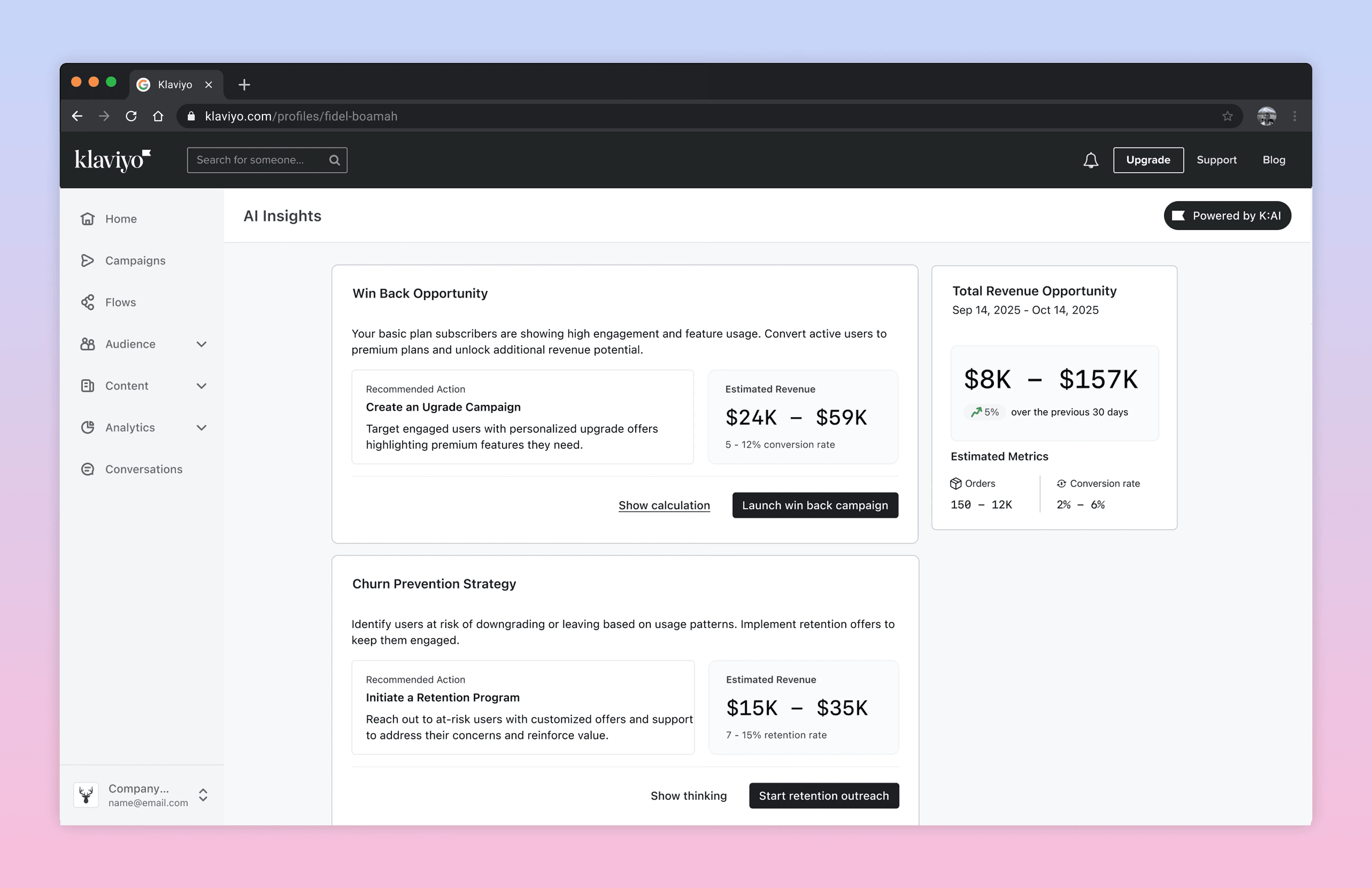
Operationalizing intelligence for a data-rich ecosystem
I spearheaded the user experience for AI-driven insights, with the aim of translating complex predictive models into actionable workflows for marketers. The work I did established a scalable design framework for agentic intelligence features and helped drive a 25% boost in attributed value.
Read the full case study
Role
Senior Product Designer
Team
2 Leads, 6 Stakeholders
Timeline
April - July 2025
The Problem
Users have to manually analyze data to find improvement opportunities at scale
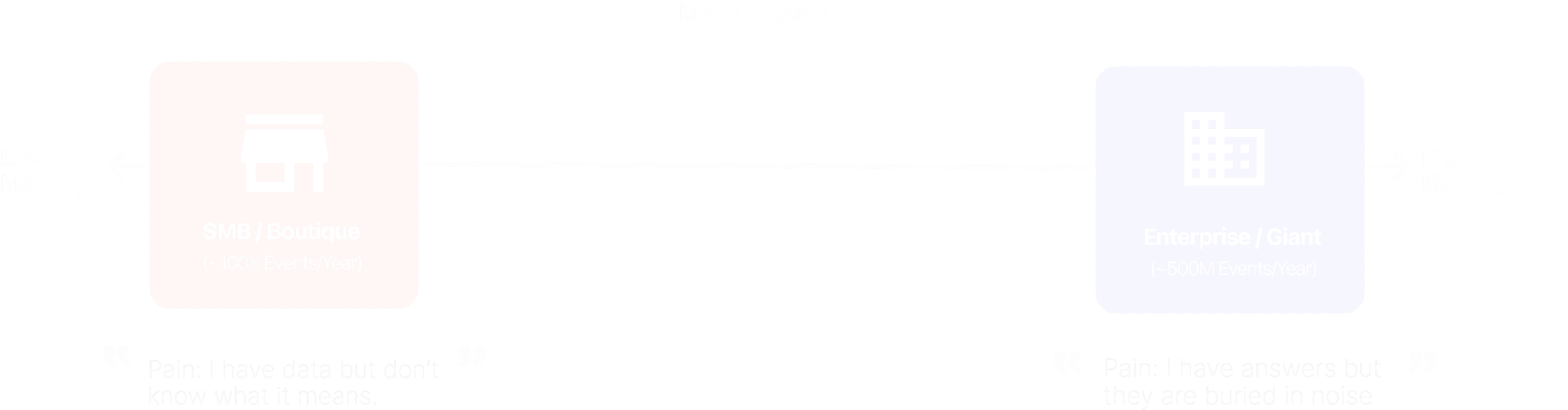
Klaviyo sits on a massive “treasure trove” of 1st-party customer data, but unlocking insights is manual, time-consuming, and gated by marketing maturity. In fact, we learned regardless of scale, raw data does not equal revenue.
The existing solution
Generic suggestions failed to drive adoption
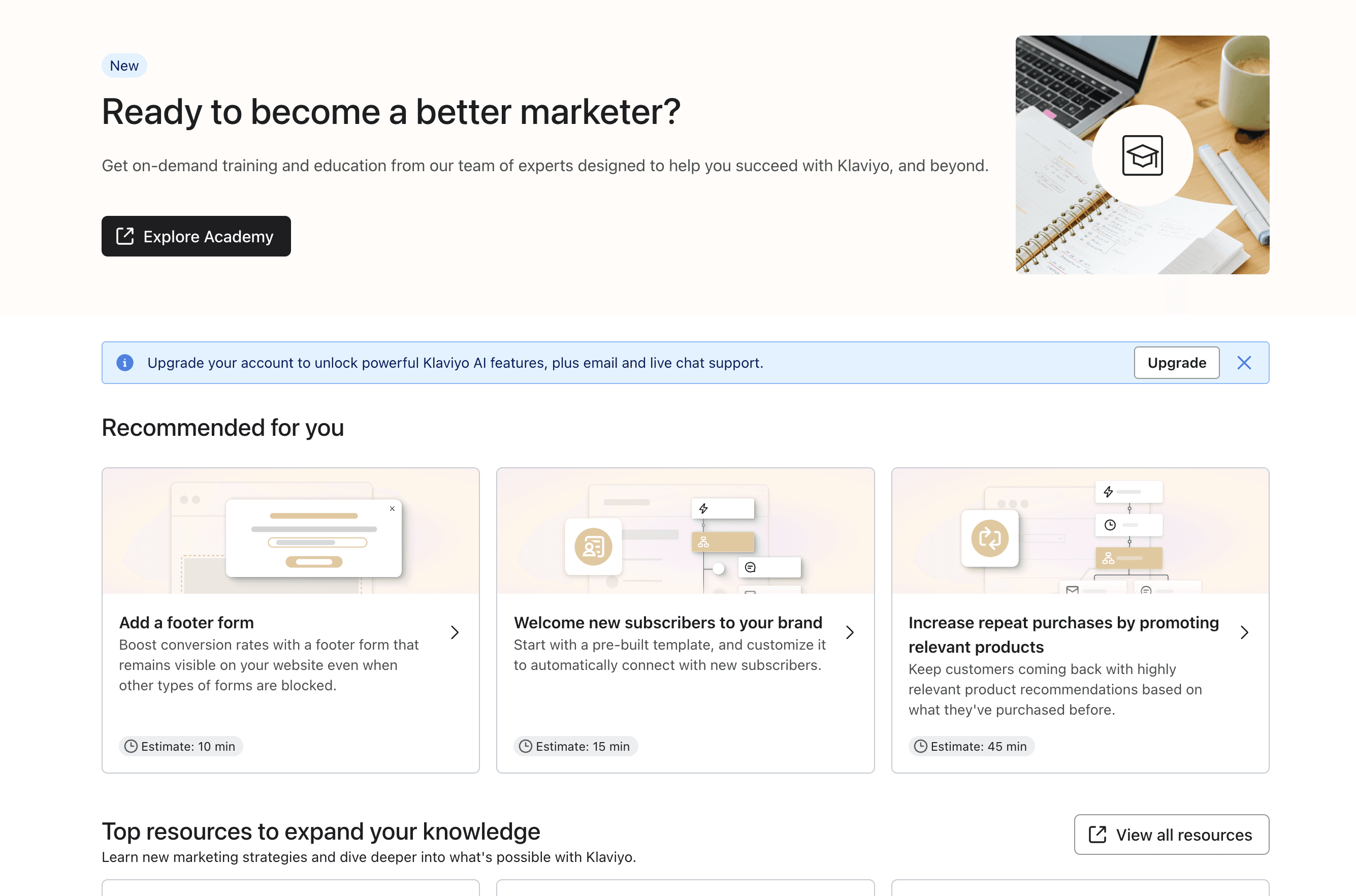
The previous experience relied on high-level account metrics to generate generic recommendations lacking specific customer context.
Instead of enabling immediate action, suggestions often redirected users to external help documentation, breaking their focus and stalling momentum.
Speaking to users
I interviewed 18 marketers across 9 industries to validate this problem
I conducted a listening tour to stress-test our hypothesis. Marketers expressed that current workflows are too technical and without proper context, data becomes a burden rather than an asset, leading to analysis paralysis.
User problems
Data density
Marketers are drowning in data silos of reports without tools to unify
High Cognitive load
Marketers spend hours reading help docs and analyzing performance
Disconnected Narratives
Marketers struggle to connect isolated metrics to business goals
Fragmented Workflows
Marketers are forced to export data into external tools to visualize trends
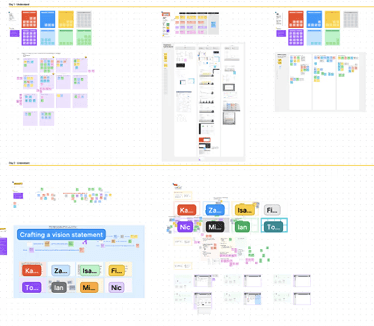
Design Strategy & Priorities
I pitched 3 strategies to move from a passive data repository to an active growth engine.
📶
Make the numbers tell a story
Users are currently drowning in dense data rows without clear takeaways. We pivoted to summarizing high-level patterns and metrics to surface immediate value
📍
Show the 'why' to earn trust
Raw data without context creates anxiety rather than clarity. We focused on increasing trust by backing every system suggestion with proven evidence and benchmarks
👆
Make it easy to take action
Users are currently drowning in dense data rows without clear takeaways. We pivoted to summarizing high-level patterns and metrics to surface immediate value
Early Dashboard concept
Abstracting performance into a gamified score
Hypothesis: Summarizing complex account data with an abstract composite score would reduce cognitive load on marketers.

Similar to a credit report, we wanted to give users an at-a-glance understanding of their performance.
We anchored the experience on a composite score (0–100) and framed recommendations as opportunities to "gain points," assuming gamification would drive action.
We simplified the data
but we lost the meaning
I stress-tested this experience with marketers and the feedback was consistent:
The "Health Score" reduced visual clutter, but increased anxiety.
The Translation Gap
Users couldn't translate a "+12 point increase" into a business outcome. The abstraction severed the link between their work and their revenue.
The Validation Barrier
Users couldn't verify the source of the recommendation, so they hesitated to act, eroding their trust in the platform's intelligence.
Defining Dashboard Features
I designed three features to help marketers validate opportunities and act on them.
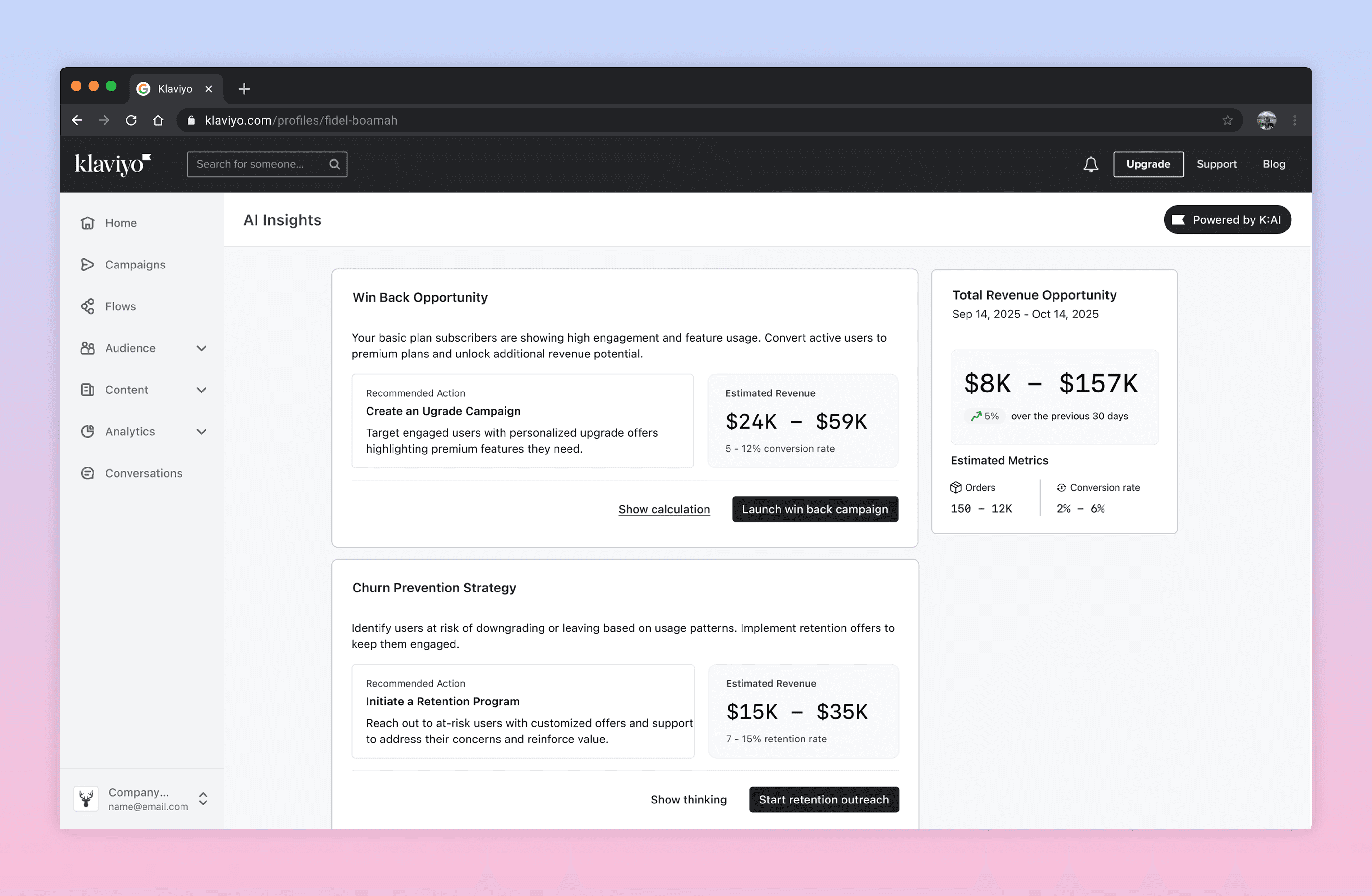
I replaced the abstract composite score with a projected revenue metric, creating a clear signal that users instinctively understand.
Total revenue opportunity
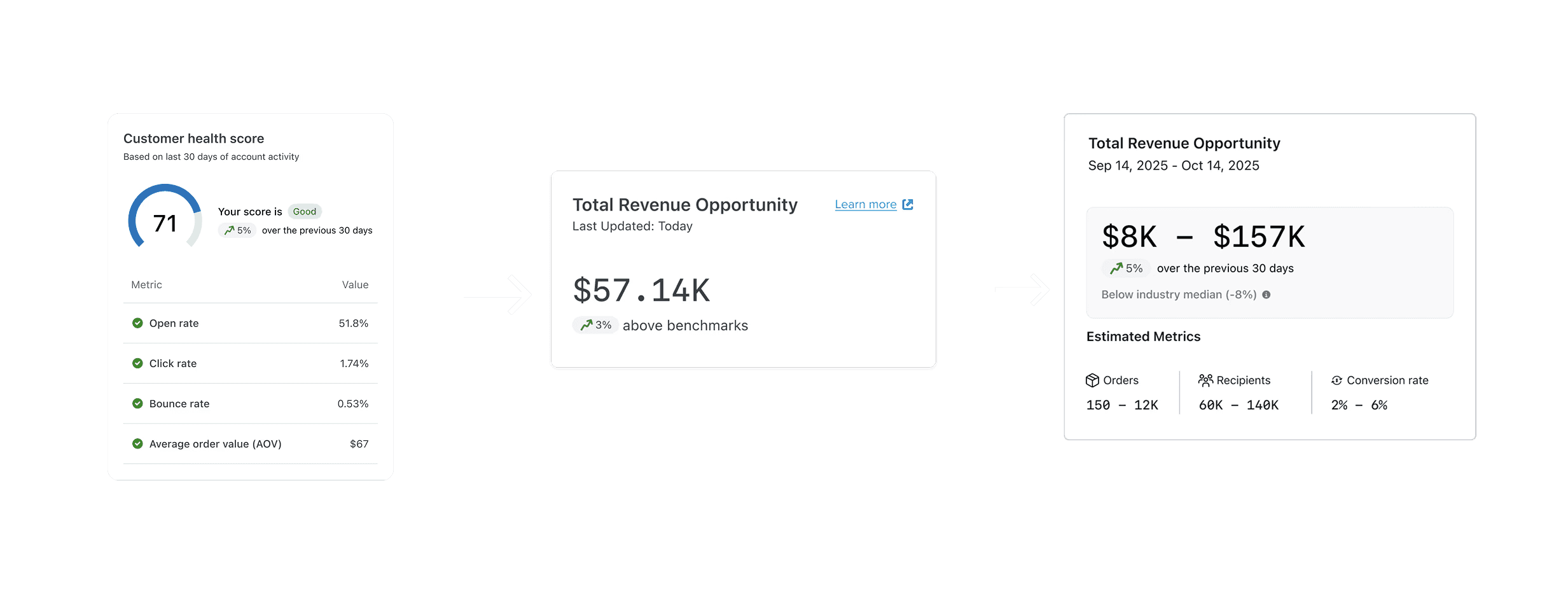
I displayed these estimates as revenue ranges backed by industry benchmarks. Acknowledging the potential margin of error, demonstrated statistical rigor and established the transparency required to build user trust.
Proactive recommendations
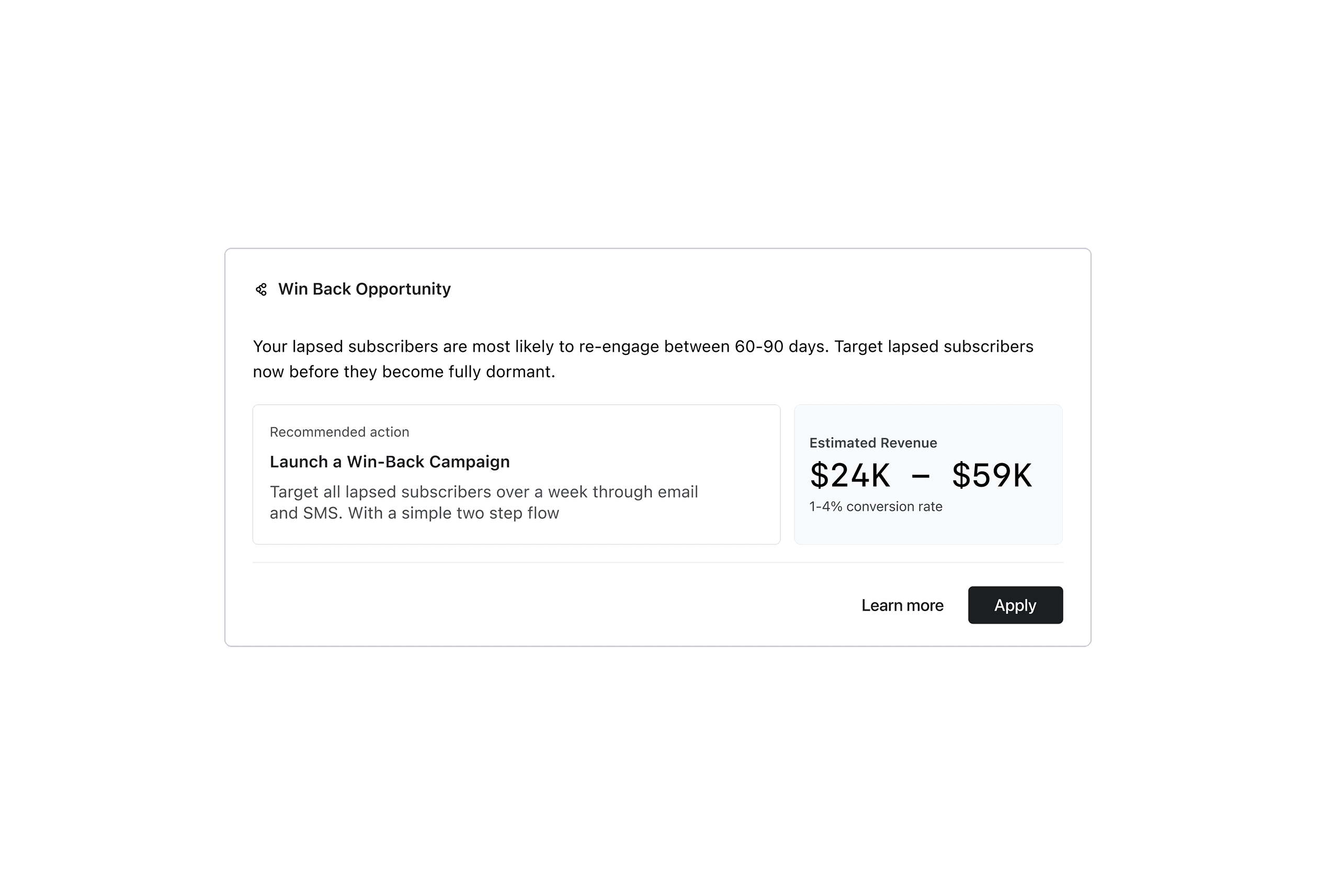
This card reveals:
the specific data pattern (the "why"),
quantifies the estimated revenue at stake (the value),
offers a direct CTA to execute the strategy.
This removes the friction between identifying an opportunity and capturing it.
Human-AI Validation flows
We designed a "human-in-the-loop" workflow to mitigate the fear of blind automation.
The AI acts as the production engine: selecting the strategy and generating full emails, SMS, and imagery but the user retains final authority.
This allows marketers to validate and configure every asset before it goes live, ensuring speed never compromises brand safety.
Final Designs
Redesigned Dashboard experience
AI Driven insights

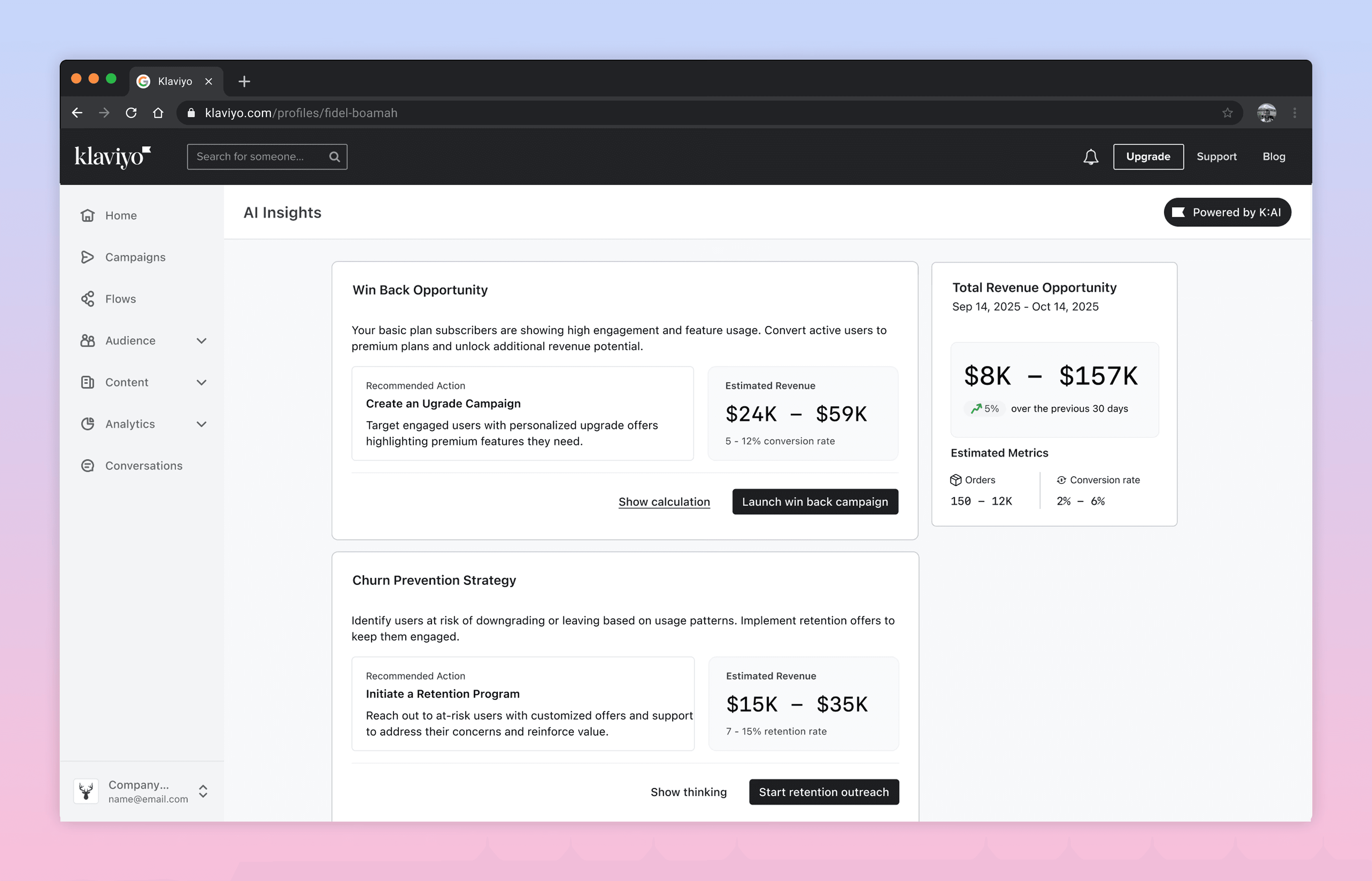
User goal: Browse opportunities and validate the logic and data that inspired the recommendation.
AI assisted workflows

User goal: Ability to act on insights immediately, speeding up workflows with AI generated content and emails.
Tracking model performance
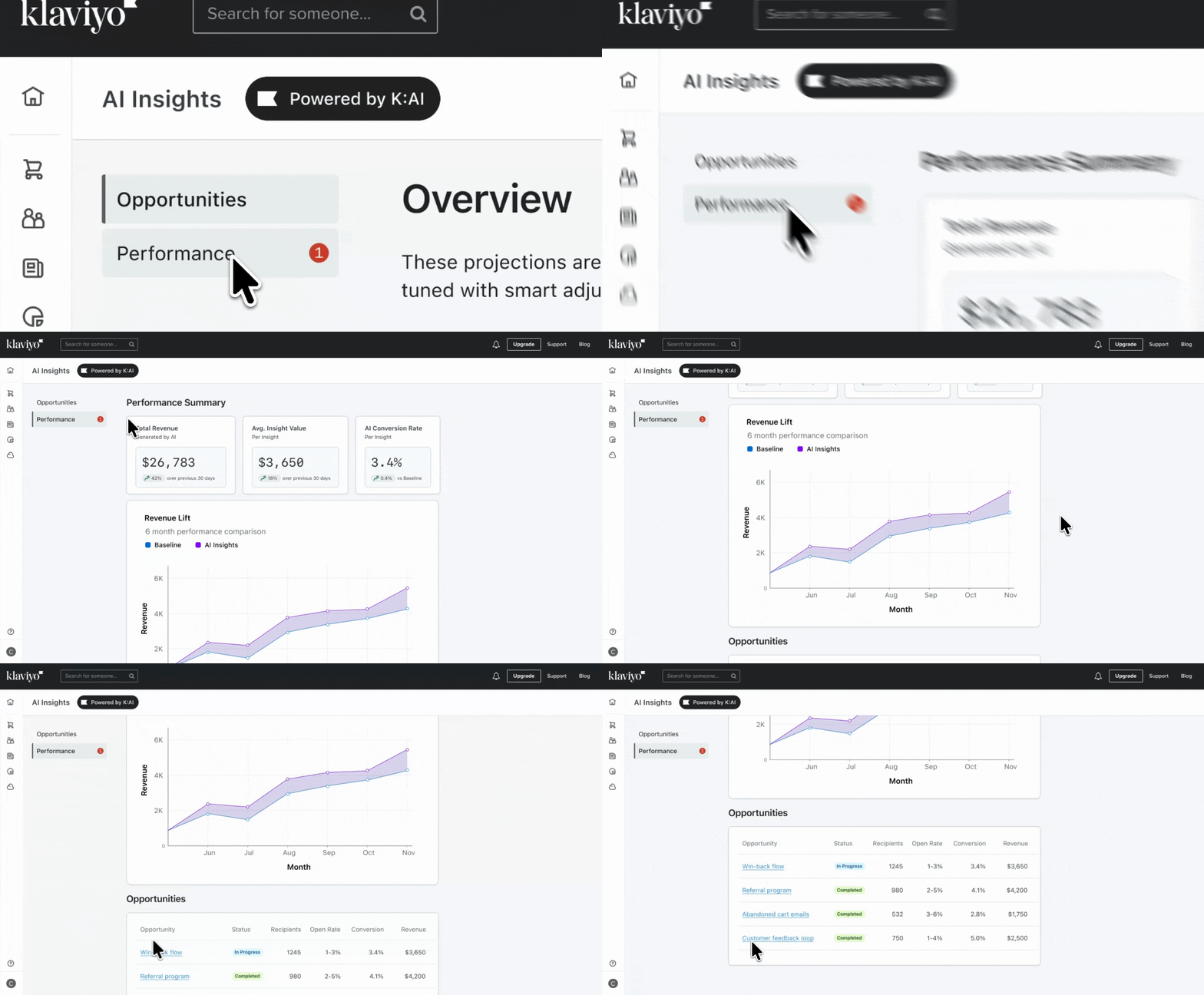
By rooting the recommendation in peer data and framing the result in revenue, we turned a generic task into a high-value opportunity that marketers felt confident pursuing. We exposed the agent's thinking to build trust, then translated that data into projected revenue. This effectively bridged the gap between platform tasks and business goals, giving users a quantifiable target rooted in reality.
Impact
We drove a 25% increase in Klaviyo-attributed value, a 14% boost in engagement, and a measurable 6 point NPS lift tied to data trust and clarity.
For customers, what once took hours of manual analysis was reduced to minutes through AI-assisted workflows. This shift from reactive analytics to guided, insight-led action reshaped how marketers leveraged data.
These outcomes shaped the AI Insights roadmap, creating a scalable framework for how Klaviyo uses AI to turn data into growth.
Klaviyo
AI B2C CRM
Operationalizing intelligence for a data-rich ecosystem
I spearheaded the user experience for AI-driven insights, with the aim of translating complex predictive models into actionable workflows for marketers. The work I did established a scalable design framework for agentic intelligence features and helped drive a 25% boost in attributed value.
Read the full case study
Team
2 Leads, 6 Stakeholders
Timeline
April - July 2025
Role
Product Designer II
The Problem
Users have to manually analyze data to find improvement opportunities at scale
Klaviyo sits on a massive “treasure trove” of 1st-party customer data, but unlocking insights is manual, time-consuming, and gated by marketing maturity. In fact, we learned regardless of scale, raw data does not equal revenue.
The existing solution
Generic suggestions failed to drive adoption
The previous experience relied on high-level account metrics to generate generic recommendations lacking specific customer context. Instead of enabling immediate action, suggestions often redirected users to external help documentation, breaking their focus and stalling momentum.
Speaking to users
I interviewed 18 marketers across 9 industries to validate this problem
Data density
Marketers are drowning in data silos of reports without tools to unify
High Cognitive load
Marketers spend hours reading help docs and analyzing performance
Disconnected Narratives
Marketers struggle to connect isolated metrics to business goals
Fragmented Workflows
Marketers are forced to export data into external tools to visualize trends
User problems
I conducted a listening tour to stress-test our hypothesis. Marketers expressed that current workflows are too technical and without proper context, data becomes a burden rather than an asset, leading to analysis paralysis.
Design Strategy & Priorities
I pitched 3 strategies to move from a passive data repository to an active growth engine.
📶
Make the numbers tell a story
Users are currently drowning in dense data rows without clear takeaways. We pivoted to summarizing high-level patterns and metrics to surface immediate value
📍
Show the 'why' to earn trust
Raw data without context creates anxiety rather than clarity. We focused on increasing trust by backing every system suggestion with proven evidence and benchmarks
👆
Make it easy to take action
Users are currently drowning in dense data rows without clear takeaways. We pivoted to summarizing high-level patterns and metrics to surface immediate value
Early Dashboard concept
Abstracting performance into a gamified score
Similar to a credit report, we wanted to give users an at-a-glance understanding of their performance. We anchored the experience on a composite score (0–100) and framed recommendations as opportunities to "gain points," assuming gamification would drive action.
Hypothesis: Summarizing complex account data with an abstract composite score would reduce cognitive load on marketers.
We simplified the data
but we lost the meaning
I stress-tested this experience with marketers and the feedback was consistent: The "Health Score" reduced visual clutter, but increased anxiety.
The Translation Gap
Users couldn't translate a "+12 point increase" into a business outcome. The abstraction severed the link between their work and their revenue.
The Validation Barrier
Users couldn't verify the source of the recommendation, so they hesitated to act, eroding their trust in the platform's intelligence.
Defining Dashboard Features
I designed three features to help marketers validate opportunities and act on them.
Total revenue opportunity
To avoid false precision, I displayed these estimates as revenue ranges backed by industry benchmarks. By acknowledging the potential margin of error, we demonstrated statistical rigor and established the transparency required to build user trust.
I replaced the abstract composite score with a projected revenue metric, creating a clear signal that users instinctively understand.
Proactive recommendations
We packaged the analysis into a single atomic unit. This card reveals the specific data pattern (the "why"), quantifies the estimated revenue at stake (the value), and offers a direct CTA to execute the strategy. This removes the friction between identifying an opportunity and capturing it.
Human-AI Validation flows
We designed a "human-in-the-loop" workflow to mitigate the fear of blind automation. The AI acts as the production engine—selecting the strategy and generating full emails, SMS, and imagery—but the user retains final authority. This allows marketers to validate and configure every asset before it goes live, ensuring speed never compromises brand safety.
Final Designs
Redesigned Dashboard experience
AI Driven insights
User goal: Browse opportunities and validate the logic and data that inspired the recommendation.
AI assisted workflows
User goal: Ability to act on insights immediately, speeding up workflows with AI generated content and emails.
Tracking model performance
By rooting the recommendation in peer data and framing the result in revenue, we turned a generic task into a high-value opportunity that marketers felt confident pursuing. We exposed the agent's thinking to build trust, then translated that data into projected revenue. This effectively bridged the gap between platform tasks and business goals, giving users a quantifiable target rooted in reality.
Impact
We drove a 25% increase in Klaviyo-attributed value, a 14% boost in engagement, and a measurable 6 point NPS lift tied to data trust and clarity.
For customers, what once took hours of manual analysis was reduced to minutes through AI-assisted workflows. This shift from reactive analytics to guided, insight-led action reshaped how marketers leveraged data.
These outcomes shaped the AI Insights roadmap, creating a scalable framework for how Klaviyo uses AI to turn data into growth.
Read the full case study
Klaviyo
AI B2C CRM
Operationalizing intelligence for a data-rich ecosystem
I spearheaded the user experience for AI-driven insights, with the aim of translating complex predictive models into actionable workflows for marketers. The work I did established a scalable design framework for agentic intelligence features and helped drive a 25% boost in attributed value.
Read the full case study
Role
Senior Product Designer
Team
2 Leads, 6 Stakeholders
Timeline
April - July 2025
The Problem
Users have to manually analyze data to find improvement opportunities at scale
Klaviyo sits on a massive “treasure trove” of 1st-party customer data, but unlocking insights is manual, time-consuming, and gated by marketing maturity. In fact, we learned regardless of scale, raw data does not equal revenue.
The existing solution
Generic suggestions failed to drive adoption
The previous experience relied on high-level account metrics to generate generic recommendations lacking specific customer context. Instead of enabling immediate action, suggestions often redirected users to external help documentation, breaking their focus and stalling momentum.
Speaking to users
I interviewed 18 marketers across 9 industries to validate this problem
I conducted a listening tour to stress-test our hypothesis. Marketers expressed that current workflows are too technical and without proper context, data becomes a burden rather than an asset, leading to analysis paralysis.
User problems
Data density
Marketers are drowning in data silos of reports without tools to unify
High Cognitive load
Marketers spend hours reading help docs and analyzing performance
Disconnected Narratives
Marketers struggle to connect isolated metrics to business goals
Fragmented Workflows
Marketers are forced to export data into external tools to visualize trends
Design Strategy & Priorities
I pitched 3 strategies to move from a passive data repository to an active growth engine.
📶
Make the numbers tell a story
Users are currently drowning in dense data rows without clear takeaways. We pivoted to summarizing high-level patterns and metrics to surface immediate value
📍
Show the 'why' to earn trust
Raw data without context creates anxiety rather than clarity. We focused on increasing trust by backing every system suggestion with proven evidence and benchmarks
👆
Make it easy to take action
Users are currently drowning in dense data rows without clear takeaways. We pivoted to summarizing high-level patterns and metrics to surface immediate value
Early Dashboard concept
Abstracting performance into a gamified score
Hypothesis: Summarizing complex account data with an abstract composite score would reduce cognitive load on marketers.
Similar to a credit report, we wanted to give users an at-a-glance understanding of their performance. We anchored the experience on a composite score (0–100) and framed recommendations as opportunities to "gain points," assuming gamification would drive action.
We simplified the data
but we lost the meaning
I stress-tested this experience with marketers and the feedback was consistent: The "Health Score" reduced visual clutter, but increased anxiety.
The Translation Gap
Users couldn't translate a "+12 point increase" into a business outcome. The abstraction severed the link between their work and their revenue.
The Validation Barrier
Users couldn't verify the source of the recommendation, so they hesitated to act, eroding their trust in the platform's intelligence.
Defining Dashboard Features
I designed three features to help marketers validate opportunities and act on them.
I replaced the abstract composite score with a projected revenue metric, creating a clear signal that users instinctively understand.
Total revenue opportunity
I displayed these estimates as revenue ranges backed by industry benchmarks. Acknowledging the potential margin of error, demonstrated statistical rigor and established the transparency required to build user trust.
Proactive recommendations
This card reveals:
the specific data pattern (the "why"),
quantifies the estimated revenue at stake (the value),
offers a direct CTA to execute the strategy.
This removes the friction between identifying an opportunity and capturing it.
Human-AI Validation flows
We designed a "human-in-the-loop" workflow to mitigate the fear of blind automation.
The AI acts as the production engine: selecting the strategy and generating full emails, SMS, and imagery but the user retains final authority.
This allows marketers to validate and configure every asset before it goes live, ensuring speed never compromises brand safety.
Final Designs
Redesigned Dashboard experience
AI Driven insights
User goal: Browse opportunities and validate the logic and data that inspired the recommendation.
AI assisted workflows
User goal: Ability to act on insights immediately, speeding up workflows with AI generated content and emails.
Tracking model performance
By rooting the recommendation in peer data and framing the result in revenue, we turned a generic task into a high-value opportunity that marketers felt confident pursuing. We exposed the agent's thinking to build trust, then translated that data into projected revenue. This effectively bridged the gap between platform tasks and business goals, giving users a quantifiable target rooted in reality.
Impact
We drove a 25% increase in Klaviyo-attributed value, a 14% boost in engagement, and a measurable 6 point NPS lift tied to data trust and clarity.
For customers, what once took hours of manual analysis was reduced to minutes through AI-assisted workflows. This shift from reactive analytics to guided, insight-led action reshaped how marketers leveraged data.
These outcomes shaped the AI Insights roadmap, creating a scalable framework for how Klaviyo uses AI to turn data into growth.
Read the full case study